+1 845 259 2974 (11 a.m to 7 p.m CST)

The Average Home Has More Connected Devices Than People, and Most Parents Haven't Counted
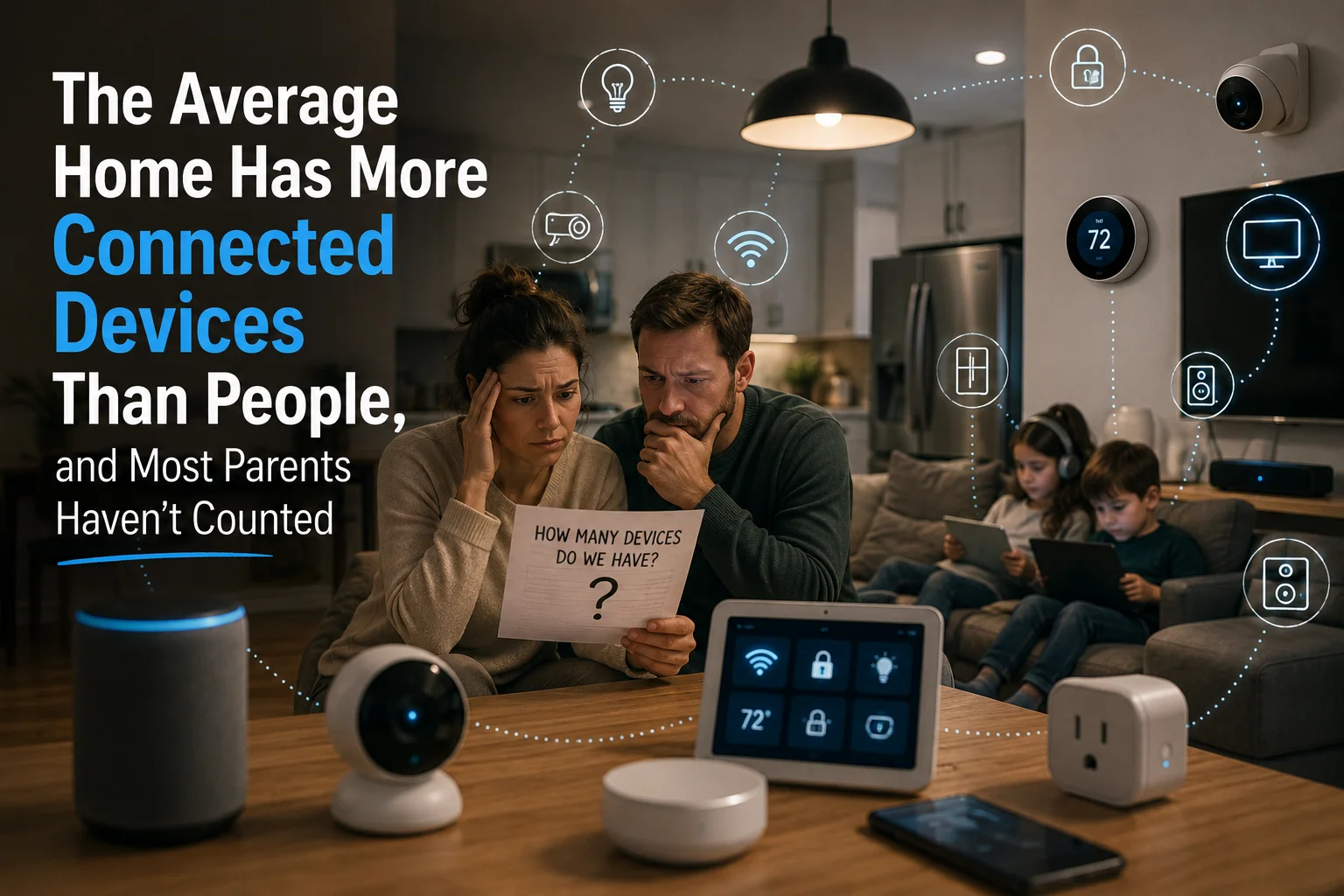
Every device on your Wi-Fi network is a door, whether it’s a smart speaker in the kitchen, a game console in a bedroom, a smart TV nobody thinks of as "online" because it just plays Netflix. Each one can send messages, stream video, download an app, or connect to a stranger, and most of them were never part of any conversation about what a child should and shouldn't have access to. Parents plan for their kid’s phone, but the rest of the network rarely gets the same attention.
Where the Extra Devices Come From
The device count in an average household outgrew the number of people living in it years ago. Parks Associates, a research firm that tracks connected-device adoption through its quarterly smart home dashboard survey, found that 45% of U.S. internet households own at least one smart home device, and 18% own six or more. The firm's April 2024 report noted a shift in the market itself: mainstream households with one to five connected devices now outnumber the smart-home enthusiast households that used to define the category.
Those numbers describe smart speakers and thermostats, not the full inventory of a house with kids in it. Add a game console per child, a spare tablet, a smartwatch, a streaming stick behind the TV, and the total climbs quickly.
Ownership Starts Years Ahead of Schedule
The 2025 Common Sense Census, a long-running national study from the nonprofit research organization Common Sense Media, found that 40% of children have their own tablet by age two. By age eight, nearly one in four have a personal cellphone.
That means the device conversation families expect to have around middle school has, for a large share of kids, already been settled years earlier by a hand-me-down iPad. A two-year-old with a tablet is not making independent decisions about what to install or where to go online. However, the device is on the network, it has an app store, and it will keep gaining capability as the child grows into it. By the time parents start thinking seriously about digital safety, the household has often had a personal device in circulation for the better part of a decade.
Early devices don't retire, either. A tablet bought for a toddler moves down to a younger sibling, or into the toy bin with its Wi-Fi credentials intact, still able to reach everything it could reach on the day it was set up. Parents rarely brace for the fact that the network has been growing since long before that moment arrived.
Software Can Only Watch What It's Installed On
Most parental monitoring tools, including apps built specifically for tracking texts, calls, and social media, work by installing on a device. That coverage is real. An app on a child's phone can flag a concerning text, log call history, and restrict which apps get downloaded. It is also boxed in by definition: it extends exactly as far as the device it lives on, and no further.
The same household usually has a game console with its own friend list and party chat, running independently of anything on the phone. It has a smart TV with a browser and an app store that never asks which family member is holding the remote. Older tablets keep their internet access long after anyone stops thinking of them as something to monitor. Consoles ship with parental controls of their own, separate from anything on iOS or Android, and plenty sit unconfigured because nobody remembers the console is a computer. None of this is visible to software that only watches the one screen it was installed on.
The American Academy of Pediatrics has moved its guidance in this direction as well, shifting away from device-specific time limits toward what it calls the "5 Cs" framework: child, content, calm, crowding out, and communication. The framework treats a household's full media environment as one system rather than a collection of separately managed screens, and it puts weight on parents modeling their own healthy device habits rather than only restricting a child's.
A household-level view only works if someone knows what the household contains. Running a household device audit once a month, alongside router-level basics like network bedtimes and filtered DNS, catches whatever slipped in unnoticed: a new console, a hand-me-down phone reborn as a Wi-Fi-only tablet, a smart speaker a relative left behind. Monitoring software protects what it's installed on. The audit is what keeps the list of things worth protecting complete.
Making the Audit Routine
An audit only works if it stays small enough to repeat. Treat it like an annual deep-clean and it happens once, then gets forgotten for two years, by which point three new devices have joined the network.
The practical version fits into five minutes at the router's admin page or app. Look at what's connected. Ask which device that unfamiliar name belongs to. Confirm the console in the kids' room isn't running with fewer restrictions than the family assumed. Router apps and mesh Wi-Fi systems now show connected devices by name and let a parent block or pause any of them directly, which turns the audit from a technical chore into something closer to checking who's home.
Grouping devices helps as much as counting them. Assigning each kid's devices to their own profile, a feature most mesh systems now include, means one tap pauses all of them at bedtime instead of six separate negotiations. It also means a new, unassigned device stands out the moment it appears.
Most of what turns up will be harmless. A neighbor's kid's phone that connected during a sleepover and never disconnected. A smart plug a grandparent left behind. Some of it won't be, and the only way to tell the difference is to look: a console running with no restrictions at all, or a device name nobody in the house recognizes. That kind of finding never gets caught by an app on someone's phone. It gets caught by someone opening the router app and reading the list.
Families who keep up with this don't treat it as a security project. They treat it the way they treat checking smoke detector batteries: a short, boring, recurring task that only matters on the one day something would have gone wrong without it.
The device count in a house with kids will keep climbing. A console today, a smartwatch next birthday, a voice assistant that arrives as a gift nobody asked for. That growth isn't avoidable, and it doesn't need to be. What changes the outcome is whether someone in the house knows, month to month, what's plugged into the network raising their kids alongside them.